Tuesday, 11 October 2016

Areas of Practise: Initial Ideas

Now I've completed some basic research and summaries, I'd like to start thinking about where to take my project in terms of making and development. To do this, I've been asking myself questions like, what methods of making and design would suit this brief? What potential does it have in different areas of practise? What kind of skills do I want to learn or expand? To answer these questions, I've thought of a series of potential project ideas as starting points that can be developed further into areas of design and making.

1) Greek Masks
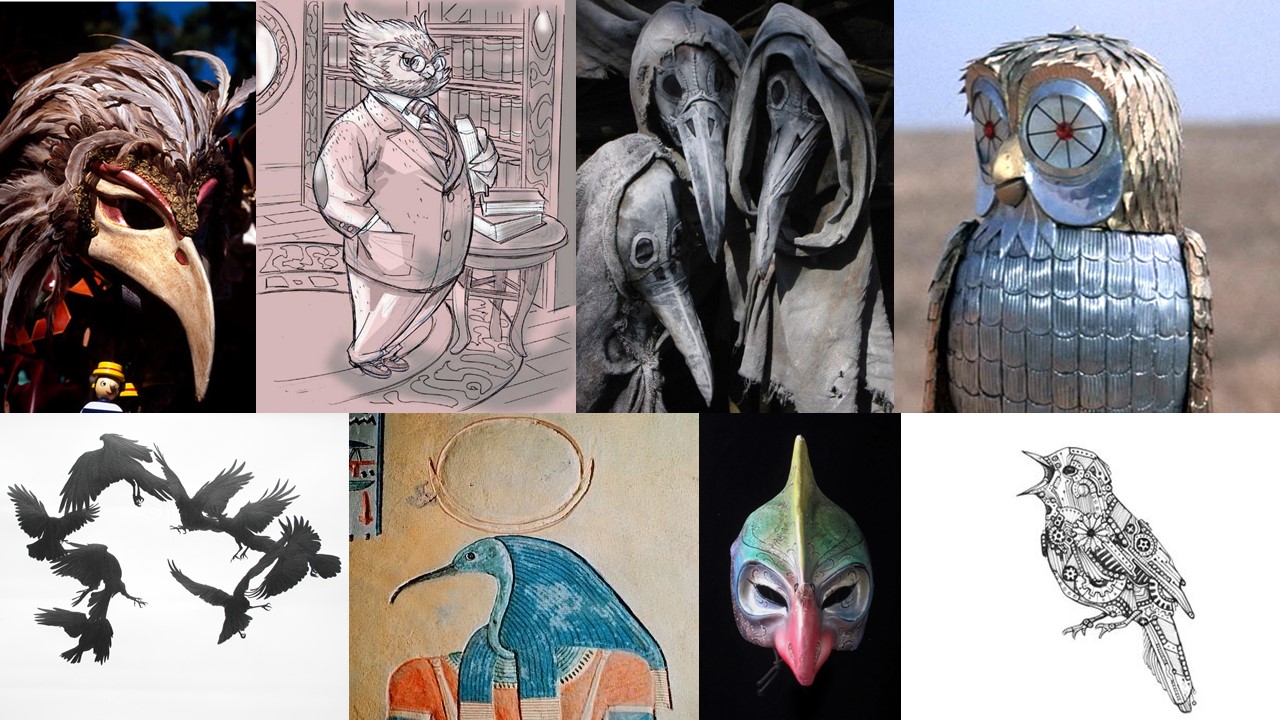
As examples such as plague doctor or Venetian bird masks have already begun to surface in my research and concepts so far, the idea of traditional Greek masks would be a very good place to link back to the original subject of Greek theatre. Conventionally, in traditional Greek theatre every actor on stage would wear a mask, the designs varying depending on the character being played, e.g. different designs for a man, a woman, a child etc. The designs themselves being symbolic of the character being portrayed.
Mask making has been something that I've been quite interested in for a while, as there are a variety of methods that can be used, including sculpting and casting, and a range of materials to chose from as well. For these reasons, a project in mask making would present diverse opportunities in both design an building, which are both skills I'd like to improve throughout this project.

2) Anthropomorphism
Animal symbolism is a theme that runs solidly through both 'The Birds' and 'The Orestia'. Working on this theme and developing it into the character design directly could be a really interesting way of experimenting with characters, e.g. How different animals could be worked into aspects of costume design, or facial features. This could also tie in very easily with the design and making of masks, as mentioned above.

3) Models/ Dolls/ Puppets for use in Stop Motion Animation.
This project would present a new area of study and research but would include skills I've already practiced and have basic ability in. I would therefore not need a lot of tuition within the aspects of making, meaning I could design a much more independent brief for myself, making this a beneficial project for third year self directed study. This skills needed could include; Scale work, sewing, casting, painting, concept art and design work. Some of these skills I've already put into practise the past two years, but this brief would present the opportunity to fine tune these creative abilities.
This project would also revolve around research, prototypes, and experiments, which really suits the framework we've already been briefed on for 'The Greeks' assignment.
The theme of anthropomorphism could also be linked into this character design project very easily. 

Friday, 7 October 2016

The Orestia: Character Relations

Above is a tree showing the relationships between all of the central characters in 'The Orestia'. This took quite a bit of figuring out but in the end it's actually clarified a lot for me regarding the relationships between characters, how they're related, etc. Below I've used the same tree but inserted red arrows to indicate who kills who, an important aspect of understanding the characters motives and relationships.  


The Birds: Character Profiling.

PEISTHETAIROS:
Traits - sneaky, ambitious, determined, sly, political, good at talking, a trickster, cunning, crafty, resourceful, gift of the gab, lazy in terms of he doesn't wanna pay tax or deal with responsibilities of society, high spirited, the leader, clever.

Relationships - friends with Euelpides, his partner in their mission for a better life. Tricks Zeus and the rest of the Gods, including Heracles, Poseidon and Tribulus. Adopts a very casual attitude when negotiating with the gods. Also tricks Epops into following his ideal, as well as his slave bird Trochilus. Gets married to Basilia, Zeus' assistant.

Goals - A better life, power, no responsibility, freedom from a government/ a society with hierarchy at which he is at the bottom of.

EUELPIDES:
Traits - follows his friend unquestionably, fades into the background after a while, forgettable, obedient. Similar to Peisthetairos but less charismatic? The friends often tease each other of their failings and their companionship is portrayed quite realistically and with good humor, they work well together in difficult situations, but this is largely due to Euelpides willingness to follow Peisthetairos.

Relationships/ Goals - Not a lot of his relationships are explored in The Birds, other than he desires the same thing as Peisthetairos and so has a common goal with his ally.

TROCHILUS:
Traits - Large and threatening, Epop's servant, demanding but persuadable, open to flattery, accuses Peisthetairos and Euelpides of being bird catchers.

EPOPS:
Traits - The script says that he is a 'not very convincing bird who attributes his lack of feathers to a severe case of molting; his could suggest that the birds are actually supposed to be humans wearing masks, or the idea of costume and mask can be translated into theatre and performance. It adds to the comedy of the play and also potentially breaks the fourth wall in allowing the audience to know that there is a costume, and that for a bird he 'isn't a convincing bird'. Happy with his life of eating and loving, married to the Nightingale,  king of the birds,

Relationships - Asked Trochilus to become a bird too when he was transformed from a man so he could continue to serve him. Likes Peisthetairos' idea of ruling over both heaven and earth, has respect for him.

Goals - He enjoys his bird lifestyle, but feels pity for the men as he used to be human too. Enjoys the idea of being above humans and Gods, came from a place of power, can't help but have the class rule ingrained in his mentality.

The Orestia Initial Ideas.


From writing up my summary of the Orestia, I've realised that the main area of interest for me are the characters of the Furies. They so far inspired ideas of potential character designs, piece of concept art, and possible areas of study that the project could manifest in. The first thoughts I had when reading about these spirits, were creepy bird like creatures of death. In the text it describes them as wearing all black, and that the 'blood must continually flow', referring them punishing the one who has already murdered, e.g. blood must continue to be spilt.
Piecing together the creepy bird creature image and possible symbols of death I could use to convey the character of the Furies to a viewer, I was reminded of the Plague doctors with their long beaked masks, empty eyes, outfits made entirely in black and the association they have with a period of history where death was prominent. This idea could also be inspired by the work I've simultaneously been doing on 'The Birds.'

The current ideas I have for the Furies are as follows:
- The continuous blood and black garments promote a red and black colour scheme.
- The idea that they are goddesses/ gods/ monsters of vengeance.
- The idea that they could be personified curses.
- Design them with the aspects of being inhuman; no gender, a monster, try to make a human the least human like I possible can?
- In that trail of thought, a robot sentinel with continuously flowing red wires? Or should this character be something more organic?
- Tribal? In the images above I've included a Tibetan death mask (lower right corner) and a carnival costume of a witch shaman lion. This tribal style really appeals to be and conveys the magic and anonymity of the Furies that I'd like to create if I choose to follow the route of this play.

The Orestia; Summary.

THE ORESTIA: SUMMARY

1) A generation before the trojan horse, two brothers, Atreus and Thyestes contended for the throne of Argos. Thyestes seduced his brothers wife, and was driven out of Argos by Atreus, who then established himself as the sole ruler. 

 2) Eventually, Thyestes returned and asked to be forgiven. Atreus pretends to forgive him, but secretly plans on the revenge for the seduction of his wife, and at the same time eliminate his competition for the throne, by proving his brother unclean and unworthy in the eyes of the citizens of Argos. 

3)  Atreus murders Thyeste's two sons, and chopping up their bodies, he serves them to his unknowing brother as a banquet, given in honor of his return. Thyestes is horrified when he learns what he's dined on. He curses his brother and all his descendants and flees from Argos, with his only remaining son, the infant Aegisthus. 

4) Atreus dies, and his thrown is inherited by Agamemnon, who marries Clytaemestra, daughter of the king of Sparta. Their children are Iphigenia, Electra and Orestes. Atreus other child Menelaus marries Helen, sister of Clytaemestra, and became king of Sparta when her father died. 

5) Most of the Greek chieftains had also been suitors to Helen, and they had made a pact to respect her choice and come to her husbands aid if anyone attempted to steal Helen from him. Sometime after Helen and Menelaus were married, Paris of Troy seduces Helen and carries her back with him to Troy. Faithful to their pact, the chiefs rally their troops and a great force was created to restore Helen to her rightful husband. 

6) Agamemnon, son of Atreus was made commander of this fleet. 

7) The expedition assembled at Aulis, but was unable to set sail due to horrific stormy weather. Calchas, a sooth sayer accompanying the army declares that the goddes Artemis was responsible and could only be appeased by sacrificing Agamemnon's daughter Iphigenia. 

8) Agamemnon was appalled at first, but eventually gave into the peer pressure from the other chiefs, and asked Clytaemestra to send their daughter to Aulis so she could marry Achilles, the greatest of the Greek gods. When she arrives, she was sacrificed and the winds immediately changed, so they set sail for Troy. 

9) Meanwhile, Aegisthus, the surviving son of Thyestes returns to Argos while Agamemnon leads the force to Helen. He begins plotting against his cousin in the hope of regaining the throne he considers rightfully his, as well as avenging his brothers and father.

10) Aegisthus discovers that since the sacrifice of her daughter, Clytaemestra developed a bitter hatred for her husband. This only grew with reports of his infidelity while he was leading the fleet. Aegisthus and Clytaemestra soon become lovers and conspire to kill Agamemnon on his return. 

11) The siege of Troy lasted ten years. Finally the city fell; The first past of the trilogy, 'Agamemnon', takes place in Argos shortly after the fall of Troy. 

12) Agamemnon returns with one ship after the rest were scattered in a storm at sea. he is accompanied by his most recent lover, Cassandra, daughter of the king of Troy. 

13) Aegisthus remains in the background while Clytaemestra gives her husband a warm welcome home. Later, she traps him in the bath and kills him with an axe. Cassandra is also murdered. Aegisthus and Clytaemestra become the new rulers. 

14) Part two of the trilogy: The Choephori. This takes place a few years later. Orestes, son of Agamemnon, was living in exile. The god Apollo tells him to avenge his father. He seeks out his sister Electra, disguises himself and murders Clytaemestra and Aegisthus. Orestes tries to justify the murder, but in the final scene he is plagued with madness and flees in terror from the Furies; hideous spirits who hunt down and punish murderers. 

15) The last play of the trilogy, begins a few days later. Orestes seeks refuge in the sanctuary of Apollo. He is forced to wander as an outcast the next few years with the furies constantly tormenting him. 

16)  Finally, he arrives at Athens, and throws himself at the mercy of the goddess Athene. The Furies follow him and insist he must be punished for matricide. He claims he acts by Apollo's orders and therefore can't be held responsible. 

17) Athene convenes a special court to hear the case, but the jurors are unable to reach a verdict. Athene casts a deciding vote and Orestes is acquitted. The Furies angrily swear vengeance on Athena, but she calms them by offering them a position of honor in the cult of her city, which they accept. The ancient Furies are transformed in benevolent spirits and their names are changed to the Eumenides, of "kindly ones" to symbolise their new characters.  

Tuesday, 4 October 2016

The Birds; Summary and Initial Ideas.

THE BIRDS: SUMMARY

When researching The Birds and reading through different editions of the text, I realised that with every translation the play was slightly disimilar, probably due to it being an old text. Overall, I gathered a simple summary together: 

1) The characters of Euelpides and Pisthetaerus leave Athens after purchasing a crow and jackdaw, after being told these birds will lead them to someone who can assist them in their quest for a quieter country, free from taxes and social responsibilities. 

2) Upon following the directions of the crow and the jackdaw in their possession, they are lead to Tricholus, slave bird to Epops, who is the character that is said to help them in discovering a new place to begin life. They flatter Tricholus, saying they wish they could be like him; carefree, devoid of debt, etc. 

3) Introduced to Epops, they ask him to direct them to a place that is more pleasant than Athens. He makes several suggestions, but none suit Euelpides or Pisthetaerus.

4) Pisthetaerus comes up with an idea to found a city. It will be built in the sky; the perfect place to control both mankind and the Gods by controlling the trafficking of sacrificial smoke, thus starving the Gods and intercepting the communication between the heavens and earth. 

5) Epops likes this idea. He awakes and summons the rest of the birds. From descriptions of the birds we can guess that they are references to public figures of the time. 

6) The other birds are startled and frightened of the two humans and decide to try and kill them. However, Epops convinces them to hear out the men by listing their virtues and flattering the birds. 

7) Pisthetaerus speaks to the birds, once again telling them they're superior and older to both Gods and men, and that they should rule over all dominions. He tells elaborate lies, drawing from myth about their history and relationship with the Gods to convince them of their superiority. 

8) The birds decide to approach Zeus and get him to surrender his power to them, otherwise they threaten that they will no longer allow him to go to earth in order to sleep with mortal women. Equally, if mankind doesn't sacrifice to the birds instead of Gods then they will destroy the crops. If they do, then they'll help then out by maintaining pests. 

9) Epops directs the men to eat a certain root that grants them wings. They begin building a city, and arranging religious ceremonies to honor the birds. 

10) A messenger announces the city complete, but a second messenger soon announces an infiltration by the goddess Iris sent by Zeus. They don't let her pass into the city, and threaten to kill her even though she's immortal. 

11) Afterwards, a Herald comes from the world below telling Pisthetaerus that thousands of humans want to join the bird city and convert to birds too. 

12) Pisthetaerus enters the bird city, masked for fear that Zeus will discover him. Zeus finds him and tells Pisthetaerus that the Gods are starving as they're not receiving any of the smoke, and leaves saying that he will sends messengers to negotiate. 

13) Heracles, Poseidon and Tribulas come in peace to negotiate. Pisthetaerus asks that Zeus yields power to him, and pitches an advantageous alliance with the birds to the Gods. The play ends with them being convinced, and the wedding party of Pisthetaerus amd Basilea, Zeus' assistant.  


Currently, the concepts I'm getting that are inspired by this text are as follows:
- a series of masks, stemmed from the idea that masks in traditional Greek theatre were very widely featured, and one of the key symbols form the contextual time era.
- The idea that the city and the birds could be mechanical.
- Anthropomorphic character designs for the different breeds of the birds.
- Egyptian transposal of the play, as that time era has a lot of similar themes the play suggests e.g. gods, heaven and earth, power, hierachy.
- The idea that the play, although a comedy is quite heavily based in politics.

Minor Project Introduction: Term 1, Year 3.

The Greeks: Minor Project, Year 3. 

To kick off the third and final year of university we've been given 'The Greeks' as a subject area and a selection of texts, poems, and plays from the era to base interpretations and transposals around. The chosen texts are as follows:

The Birds by Aristophanes. 
Lysistrata by Aristophanes. 
The Odyssey by Homer. 
The Orestia by Aeschylus.
The Restless House by Zinnie Harris.
Medea by Euripides.
Oedipus Rex by Sophocles. 
Greek by Steven Berkoff. 
Iphegena in Splott by Gary Owen.

Upon reading and researching each of these texts individually, the two that I find myself most interested in are the 'The Birds' and 'The Orestia'. Both of these have the potential for a lot of character/ world design and creation which are areas that I'm personally interested in and would like to use this project to explore further. 

Certain areas of practice and research that I'd particularly like to use in terms of developing my project will be soundtracks, aesthetics, location hunting, and areas of inspiration from artists, designers, developers etc. 

Areas of focus and concepts that sprung to mind when discovering the theme of Greek theatre for the term include mythical monsters, animal symbolism, myth and magic, solar and lunar cycles, gods and mortals; themes thought of with a quick brainstorm. My first stages of development will be researching the plays further and deciding which one I will focus on, as well as deciding on potential making and design projects to undertake.